










Aguaduna will be a real estate project that would be both an ecosystem of open innovation and a model of a smart and sustainable city, dedicated to restoring the balance between society and nature.
Thus was born the conception of Aguaduna, which will bring together in the same housing and urbanistic complex tourism and technology business centres in the municipality of Entre Rios, on the northern coast of Bahia.
Aguaduna has the support of multidisciplinary teams in Spain, Brazil and the United States, as well as strategic partners such as Siemens, responsible for implementing solutions and technologies that aim to transform the city into a reference in the use of data. Digital services and big data will be used in areas such as electrification, waste management, security and mobility.
In addition to Siemens, companies such as SegurPro, Enel X, Cetrel, Atos and the World Tourism Organization (UNWTO) are supporting the project. The Aguaduna smart city has an estimated total investment of 2 billion euros. Of this total, more than 20 million euros have already been invested in the first phase of construction.
the latest news
These are a compilation of news on different areas of sustainability. You will find news about the circular economy, social economy, innovation, and other relevant areas.
Big things are happening for Aguaduna! Our co-founder Manuel Matutes Mestre and Corporate Director of Social Responsibility Gabriela Cruz had a productive meeting with Natalia Bayona, Director of Innovation, Education and Investment at World Tourism Organization (UNWTO) and Mauricio Bacelar, Secretary of Tourism of Bahia, to discuss our future plans for this smart destination.
Gabriela Cruz and Manuel Matutes discussed the importance of community-based tourism for their project in Bahia’s Aguaduna region. We believe that involving local communities in the development and management of tourism in the area will not only benefit the economy but also preserve the cultural heritage and improve the quality of life for the residents.
The tourism sector remains very attentive to its recovery after the impacts caused by the COVID-19 pandemic, but not only because of the need to resume its growth. Although 2020 was the most challenging year in the history of the sector, with a 74% drop in the volume of international travels compared to 2019, according to the World Tourism Organization (UNWTO), it is important to see the opportunities arising from this scenario.
In 2022 the Smart City Expo World Congress was tremendous. At this edition were more than 20K in-person attendees and more than 400 speakers from 134 countries.
Kei Cities took part in the incredible panel, “StartUp Cities: Mediterranean ScaleUp”, where participated Elena González Sánchez (Chief Energy Services Officer ACCIONA Energía), Anders Frostenson (Director at EY across EMEIA), David Schwartz (VP of Global Tech Venturing), Natalia Olson-Urtecho, Kei Cities Advisor and our co-founder Tarek Al Masri.
The speakers discussed the similarities between the Mediterranean cities and the blue economy. Our co-founder, Tarek Al Masri, addressed the need to help mayors take good decisions for a sustainable future. In this sense, Kei Cities will launch its platform to measure, monitor and evaluation the implementation of the SDGs.
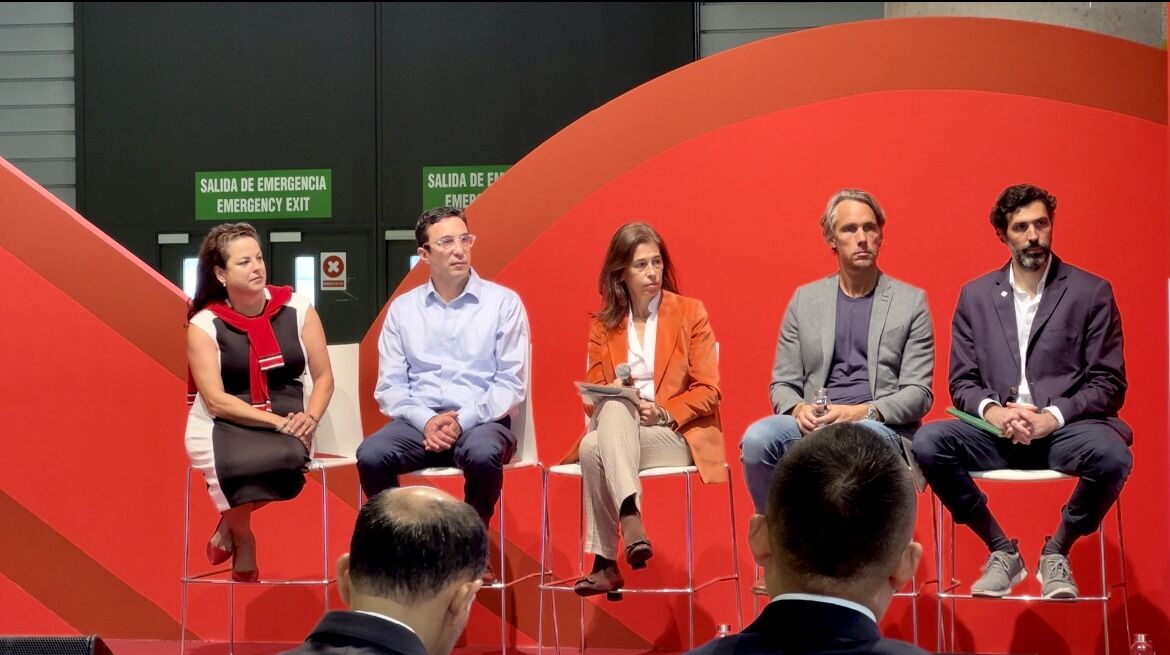
Our co-founder Manuel Matutes Mestre and our head of innovation, Karim Masri, were presenting about Aguaduna and our mobility proposal during the micro event organized by Universitat Internacional de Catalunya, “Optimizing Mobility & Resources through public Smart-Tech”. You can see their lectures on our youtube at the following link: https://youtu.be/qNViE2MuZIA
Fresh Water Nature SL (FWN), a spin-off company of the International Centre for Numerical Methods in Engineering (CIMNE), has recently installed an experimental prototype for the production of fresh water at the desalination plant of the Ente de Abastecimiento de Agua Ter-Llobregat (ATL) located in the municipality of El Prat de Llobregat, in Barcelona.
FWN’s freshwater production technology is based on the Cool Steam technology patented by CIMNE. Cool Steam is a desalination technology based on a multi-stage vacuum distillation process that harnesses excess energy from industrial processes or nature, and can produce fresh water from salt water (even if it has a very high concentration of salts, brackish water or seawater).
Cool Steam technology operates at low temperature and requires a low overall temperature gradient, which facilitates the use of low-grade heat sources to perform the thermal desalination process.
The FWN prototype has successfully achieved a freshwater production rate of about 12 litres/hour, the target set by this experimental prototype.
The experience gained during the field experiment helped to scale up the freshwater production process in the FWN pilot plants planned for the coming months.
In the Aguaduna project in Brazil and the Aledo project in Spain, an up scaled desalination plant with a capacity of 10 m3/day will be installed.
Students from the Universitat Autònoma de Barcelona present biotechnology as the use of living organisms or parts of organisms to produce goods and services.
Their main objective focuses on the use of plants to generate electricity in a sustainable and low-cost way.
Bio (Arkyne) is a clean-tech company that generates electricity from plant photosynthesis. Bioo, which was founded by Javier Rodriguez Macías, Pablo Vidarte Gordillo and Alexandre Díaz Codina, presents the challenge as a startup to provide electricity to cities, companies and homes with the energy generated by their gardens. The innovations presented by Bioo are based on the technological integration of the scientific fields of: Biology, Biotechnology and Advanced Electronics, leading to a simple concept “a biological fuel cell”.
The principle of this cell is based on the fact that plants, during the process of photosynthesis, expel organic substances through their roots, these, once deposited, pass to the biological pile and there the specific micro-organisms of Bioo, decompose the substances and release electrons, captured by the electronic system that transfers them to the output electrical network of the biological cell for direct use.
Hydrogen atoms are also released during the process, which can combine with external oxygen to form water.
The startup currently has two products in development: Bioo Panel-panels that when interconnected can power homes or buildings and Bioo Lite-the first flower pot that can charge your mobile phone with electricity from the plant.
Kalundborg Symbiosis is a partnership between fourteen public and private companies in Kalundborg. We also work closely with the Biopro project.
Together, since 1972, we have developed the world’s first industrial symbiosis with a circular approach to production.
The main principle is that a waste stream in one company becomes a resource in another, benefiting both the environment and the economy. In a local partnership, we can share and reuse resources, thus both saving money and minimising waste.
The symbiosis creates growth in the local community and supports the green transition.
FWN’s freshwater production technology is based on the Cool Steam technology patented by CIMNE. Cool Steam is a desalination technology based on a multi-stage vacuum distillation process that harnesses excess energy from industrial processes or nature, and can produce fresh water from salt water (even if it has a very high concentration of salts, brackish water or seawater).
This newsletter is addressed to everyone in the sustainability and smart cities sector. We have for you below the main news of this month.
